Optical Sorting Machine for Zero-Defects Inspection
High-speed, automated inspection systems for fasteners, automotive, and precision parts
What is an Optical Sorting Machine and Why Should You Choose One?
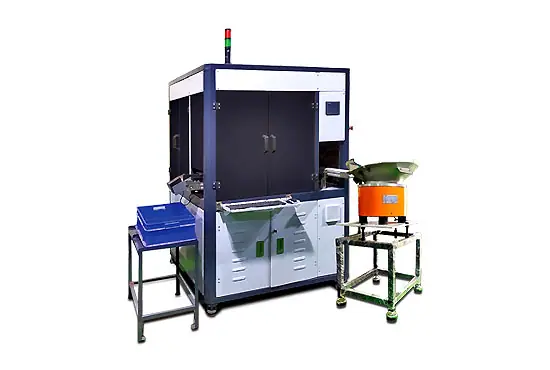
An Optical Sorting Machine is an automated inspection system that uses cameras, sensors, and vision software to inspect components for defects. It evaluates each part based on its dimensions, shape, geometry, and surface condition, identifies parts that do not meet the defined inspection criteria, and automatically separates them from accepted parts. This enables manufacturers to achieve faster, more accurate, and consistent quality inspection.
By reducing dependence on time-consuming manual inspection, an Optical Sorting Machine helps manufacturers improve inspection speed, minimize human error, maintain consistent quality, and achieve Zero-Defects Inspection. It is particularly useful for high-volume production environments where every component needs to be inspected accurately and efficiently.
How Does an Optical Sorting Machine Work?
By reducing dependence on time-consuming manual inspection, an
Optical Sorting Machine helps manufacturers improve inspection speed,
minimize human error, maintain consistent quality, and achieve a
zero-defect inspection process. It is particularly valuable for
high-volume production environments where every component needs to be
inspected accurately and efficiently.
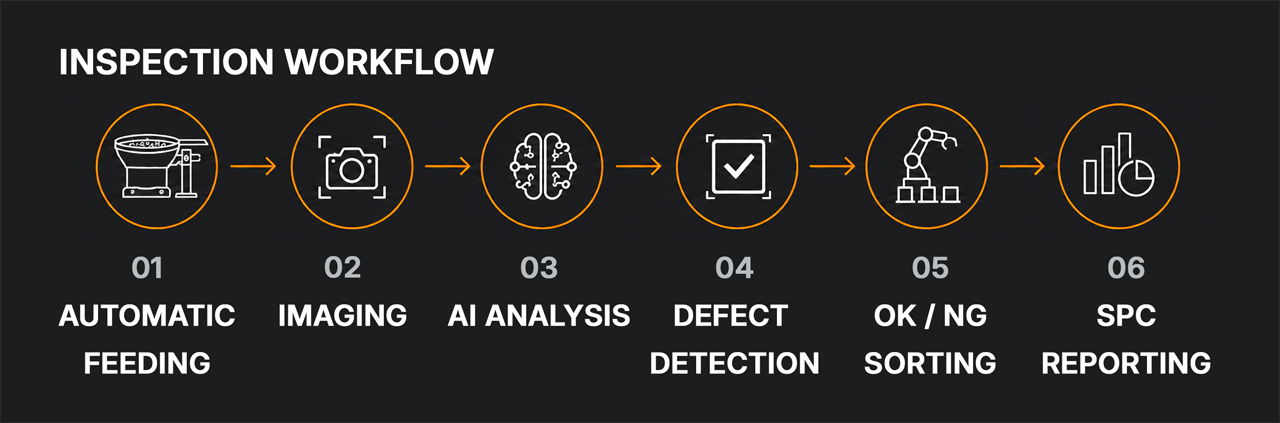
The inspection process starts with automatic feeding, followed by
high-speed imaging of every component. Advanced
AI-powered vision analysis evaluates critical features and identifies
defects with precision. Detected defects are automatically classified through
defect detection, while the system performs
OK/NG sorting to separate good and defective parts. Finally,
SPC reporting provides valuable quality data for process monitoring,
traceability, and continuous improvement.
Key Benefits of using an Optical Sorting Machine ?
Boost Efficiency – Inspect up to 300 parts per minute (PPM) without compromising quality.
Catch Every Defect– From visible cracks to micron-level deviations.
Reduce Costs– Lower costly recalls/ rework, and labor expenses.
Improve Traceability -Get inspection reports for audits and compliance.
Quick ROI – Many businesses recover the investment within 12–18 months.
Electronics: Screws, pins, connectors with tight tolerances
Industrial Fasteners: Bolts, nuts, rivets, and washers
Is an Optical Sorting Machine Suitable for High-Speed Production?
Yes. Modern Optical Sorting Machines are designed for high-speed inspection environments. These machines can inspect multiple parameters in a fraction of a second without compromising quality, making them ideal for industries such as automotive, electronics, rubber, and precision engineering. Learn more about Varad Automation and Robotics.
Customization for Your Industry
Optical sorting machines can be tailored to suit as per part type, defect criteria, and throughput needs. Whether you need shape based sorting, surface defects or size-based rejection,or all above; the customization is available.
Business Impact: ROI of Optical Sorting Machines
Despite the initial investment, optical sorting machines deliver quick ROI through:
Save on labor costs by reducing manual inspection teams
Prevent costly recalls and rework by consistent, precision inspection.
Ensure customer satisfaction with zero-defects delivery
On average, companies recover their investment in 12–18 months — and continue saving for years to come.
Nationwide Support You Can Trust
Visimaster provides complete end-to-end support across India:
Installation and commissioning
Operator training for smooth adoption
Preventive maintenance and spare parts availability
Remote diagnostics for minimal downtime
With a strong presence across the country— Pune, Mumbai, Delhi, Bengaluru, Ahmedabad, Chennai, Kolkata etc. we are always within reach.
FAQs About Optical Sorting Machines
Q1: Can optical sorting replace manual inspection?
Yes. An Optical Sorting Machine removes the limitations of human inspection by working faster, with consistent accuracy, and without fatigue. This makes it far more reliable for high-volume production.
Q2: What defects can it detect?
The system can identify surface scratches, cracks, dents, and even micron-level dimensional variations that are difficult or impossible to detect manually.
Q3: Is it suitable for small parts like fasteners?
Absolutely. Optical Sorting Machines are widely used for small precision parts including fasteners, washers, turned components, and automotive parts.
Q4: How reliable is the machine long-term?
With routine preventive maintenance, Optical Sorting Machines deliver stable performance for years, ensuring continuous inspection without unexpected downtime.
Q5: What industries benefit the most from optical sorting?
Industries like automotive, electronics, and manufacturing rely heavily on optical sorting to achieve zero-defect quality standards.
Looking for a reliable Optical Sorting Machine?
Contact our experts today to discuss your inspection requirements and explore a tailored solution designed for your parts and industry.
Each success story reflects our commitment to quality, consistency, and customer satisfaction. 👉 For more stories like these and live updates, visit our official LinkedIn page.
We regularly share real-world case studies, automation insights, and industry innovations that inspire.