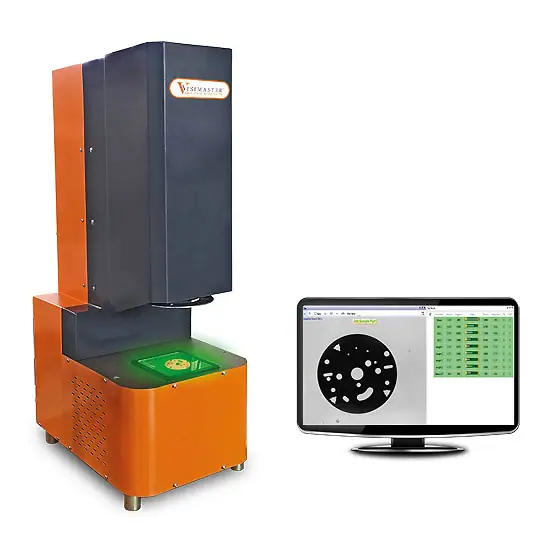
Vision Measurement System for Precision Optical Measurement
A Vision Measurement System is a non-contact optical measurement solution that uses cameras, precision optics, controlled lighting, image processing and measurement software to measure component dimensions.
It enables fast, repeatable dimensional measurement and inspection while reducing dependence on manual measurement methods. Measurement results can also be recorded for batch reporting, SPC analysis and quality traceability .
What is a Vision Measurement System?
A vision measurement system captures an image of a component and analyzes its geometry using optical and image-processing technologies.
Instead of physically contacting the component, the system can measure features such as edges, diameters, distances, radii and other geometric characteristics from the captured image.
This makes vision-based measurement suitable for precision components where non-contact, repeatable and consistent dimensional inspection is required.
How Does a Vision Measurement System Work?
The basic measurement process includes:
Part positioning – The component is correctly presented to the optical system.
Controlled illumination – Lighting creates clear contrast between the component and its background.
Image acquisition – An industrial camera captures the component image through precision optics.
Image processing – Software identifies edges and relevant geometric features.
Dimensional measurement – Measurement algorithms calculate the required dimensions.
Tolerance evaluation – Results are compared with predefined specifications.
Data recording – Results can be stored for reports, SPC and traceability.
Key Technologies in a Vision Measurement System:
Industrial Vision Camera
The camera captures high-quality images of the component for dimensional analysis. Camera selection depends on the component size, required field of view and measurement requirements.
Precision Optics
Lenses determine how the component is projected onto the camera sensor. Suitable optics are essential for obtaining a stable and measurable image.
Controlled Illumination
Proper lighting helps create clear component edges and reduces the effect of reflections, shadows and surface variations.
Image Processing
Image-processing algorithms convert the captured image into usable measurement information. Techniques such as edge detection and feature extraction help identify geometric characteristics.
Measurement Software
The software performs measurements, evaluates tolerances and manages inspection results. It can also support measurement programs, batch records and SPC data.
What Factors Affect Vision Measurement Performance?
Measurement performance depends on the complete system rather than the camera alone. Important factors include:
Component size and geometry
Required tolerance
Camera resolution
Lens and field of view
Lighting conditions
Part positioning
Surface finish and reflectivity
Calibration quality
Mechanical stability
Software and measurement algorithms
Operating environment
Therefore, system selection should be based on the complete measurement application, not only camera resolution or a stated micron value.
Vision Measurement System for Quality Control
A vision measurement system can support quality control by providing consistent measurement results across production batches. It can help manufacturers:
Reduce manual measurement time
Improve measurement consistency
Identify dimensional deviations
Record inspection results
Generate batch-wise reports
Monitor process variation through SPC
Improve traceability
Support automated quality decisions
Non-Contact Optical Measurement
One of the major advantages of vision measurement is non-contact inspection .
Because measurement is performed from an optical image, the component does not need to be physically contacted by a probe or gauge.
This can be useful for:
Delicate components
Small precision parts
Components that may deform under contact
High-volume dimensional inspection
Applications requiring repeatable measurement
When Is a Vision Measurement System Suitable?
Vision measurement is particularly suitable when you require:
Multiple dimensional measurements
Non-contact inspection
Repeatable measurement results
Faster inspection than manual methods
Digital measurement records
SPC and batch reporting
Integration with automated inspection
Consistent quality evaluation across production
Application suitability should always be evaluated using the actual component, drawing, tolerances and production requirements.
How to Select the Right Vision Measurement System
Before selecting a system, consider:
Component size, geometry and material
Dimensions features and parameters to be measured
Tolerance: required measurement capability
Production volume: required inspection rate
Surface : finish, reflectivity and contrast
Data: reporting, SPC and traceability requirements
Integration: existing machines and production systems
A practical application study is recommended before finalizing the optical configuration.
Applications of Vision Measurement Technology
Vision measurement systems can be used for dimensional inspection of:
Precision machined components
Automotive components
Turned parts
Brass and metal components
Plastic components
Rubber components
Stamped components
Small precision parts
Typical applications include dimensional verification, production quality control, sorting and automated measurement.
Industries Using Vision Measurement Systems
Vision measurement technology can support quality inspection in:
Automotive
Precision engineering
Fasteners
Electronics
Medical and healthcare components
Brass and metal components
Plastic and rubber components
General manufacturing
Find the Right Precision Measurement Setup for Your Components
Have a component that requires precision dimensional measurement? Share your component drawing, dimensions, tolerances and inspection requirements with our team to determine the appropriate vision measurement approach.
Want to know how our Vision Measuring System delivers precise inspection? Explore our insights on LinkedIn.